
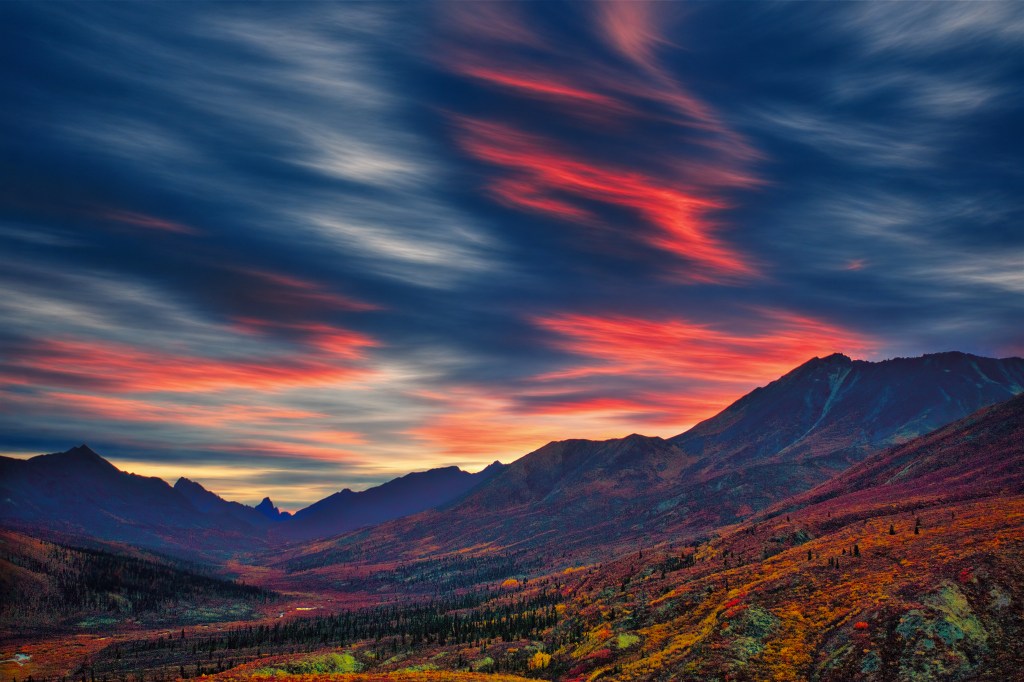
The first thing that catches me is the red. It spreads across the floor of The Klondike River Valley in broad, uneven patches; scarlet fading into rust, deep burgundy pooling beneath slopes washed in gold. Above it all, dark mountains rise into a restless sky, their broken summits sharp enough to look unfinished. I stand looking into the valley, trying to take in a landscape that seems to grow larger the longer I watch.
Here in the Yukon’s Tombstone Territorial Park, autumn arrives while much of the continent is still holding on to summer. By late August, color often begins spreading through the valleys and across the hillsides. At its peak, the transformation reaches from the low vegetation underfoot to the distant mountain slopes.
The air has a clean, cold edge. A breeze moves through the shrubs with a dry whisper, carrying the earthy smell of damp ground and fading leaves. Sunlight breaks through a gap in the clouds, and a hillside suddenly brightens. For a few seconds, every yellow leaf seems to catch the light individually. Then the opening closes, and the slope settles back into amber shadow.
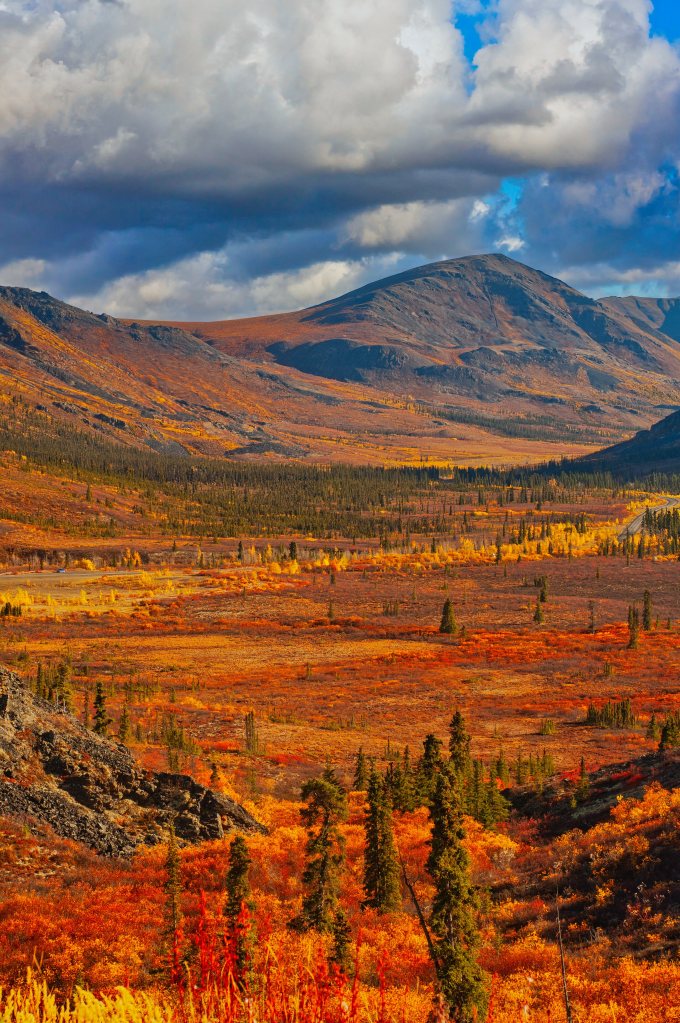
My eyes keep moving between the mountains and the ground. The skyline demands attention, but so much of the beauty is small. Tiny leaves overlap in shades of copper and crimson. Pale lichens branch across stones. Moisture gathers along the edges of vegetation, catching fragments of sky. Close to the earth, the tundra becomes a landscape of its own, intricate enough to make me forget the peaks for a moment.
Then I look up again. Beyond the rolling foreground, the valley draws my gaze toward a gathering of jagged summits. Loose rock spills down their flanks in gray fans, and dark gullies cut through the slopes. The autumn vegetation softens their lower reaches, but higher up, the color gives way to exposed stone. That transition is striking: the warmth of the valley beneath the cold, severe geometry of the mountains.
As a photographer, I find myself waiting more than shooting. A cloud shadow travels slowly across the foreground, darkening the reds before climbing a distant ridge. Behind it comes another sweep of sunlight. The same view rearranges itself without anything seeming to move. I frame a photograph, lower the camera, and wait. There is always another detail just outside the composition: a curl in the valley, a gold slope beneath a charcoal ridge, a strip of brightness slipping between shadows. The camera gives me a reason to study these things, though the longer I stand here, the less urgency I feel to press the shutter.
What stays with me is the sense of a season moving quickly. The leaves still hold their color, but the wind already feels capable of stripping them away. In the shadows, the cold lingers. Across the valley, clouds collect around the highest rock, briefly concealing the summits. I linger through one more passage of light. It moves across the valley floor, warming the red shrubs and picking out folds in the hills I had barely noticed before. For a moment, the distance feels almost touchable.
Then the sun disappears again. The colors deepen, the mountains darken, and I can hear the wind moving through the leaves.





Leave a Reply